

Fear Has a Map
On childhood road trips through the South, Louisiana v. Callais, and the enduring American fear of Black political power

As a child, my little brother and I traveled by car with my parents from Southern California to northeast Mississippi. Long before GPS and smartphones. Just highways, paper maps, gas stations, motel signs, and the changing landscape outside the window.
I remember being mesmerized by the South itself. The trees, especially. Southern trees are different. Dense and towering and impossibly green. They felt ancient to me as a child, almost holy. I would sit quietly in the backseat staring out the window for hours as the scenery rolled by.
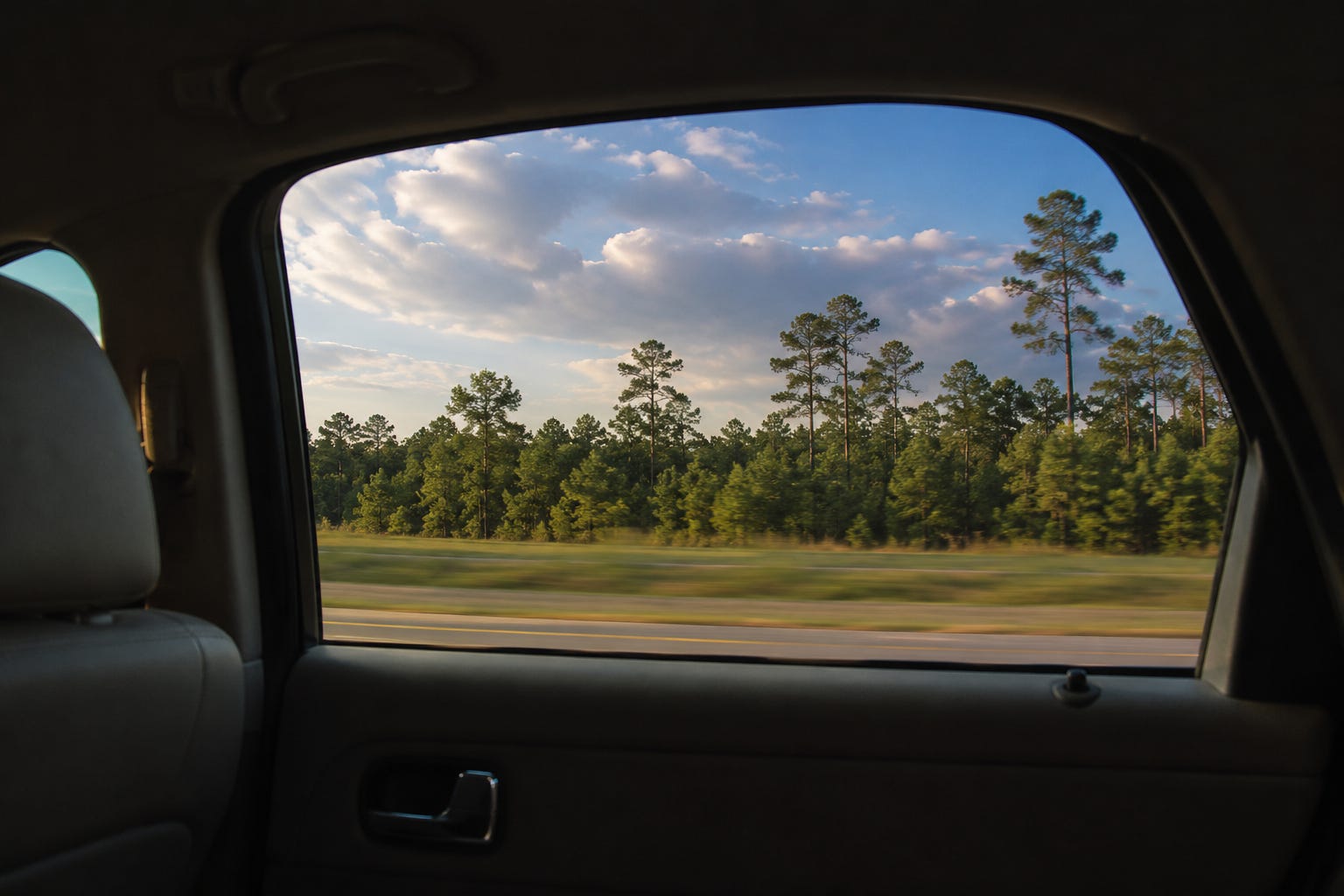
But alongside that beauty, there was always tension in the air as we approached certain places.
I remember hearing it most clearly in my mother’s voice as we got closer to Louisiana. She would ask my father if we had enough gas to make it straight through. She wanted to make sure we crossed northern Louisiana during the daytime. There was urgency in her voice, but also restraint, the kind adults use when children are listening.
At the time, I didn’t fully understand what I was hearing. I do now.
Those weren’t ordinary travel concerns. They were racial calculations. Safety calculations. The inherited instincts of Black Americans who understood that geography in this country could change the temperature of your vulnerability. My parents knew what certain stretches of road represented historically. They knew that danger in America did not always arrive with warning signs. Sometimes it arrived as a broken-down car at dusk. Sometimes it looked like needing gas at the wrong exit. Sometimes it looked like being too visible in the wrong town after dark.
Fear has a map in this country. And maybe that is why I have been thinking about Louisiana so much this week.
More specifically, I have been thinking about the Supreme Court’s decision in Louisiana v. Callais and the speed with which states moved afterward to redraw political maps in ways that will almost certainly dilute Black voting power. Louisiana. Alabama. Tennessee. The urgency was striking. Mid-cycle. In the middle of active political processes. In the middle of a storm. Suddenly, there was tremendous clarity, focus, and institutional energy around changing maps of Black representation.
And I thought to myself: this is so very American.
We are living in a moment where the words diversity, equity, and inclusion are being publicly mocked, challenged, legislated against, and reframed as unnecessary intrusions into American life. Entire industries are backing away from the language as though fairness itself has become embarrassing. But then moments like this happen, and I want to ask plainly: if equity and inclusion are no longer needed, then what exactly are we looking at here?
Because this situation tells a very old story.
The legal language surrounding the case will sound technical and abstract. Constitutional interpretation. Race-conscious districting. Section 2 standards. Competing doctrines. But underneath all of that legal architecture is something painfully familiar: White America’s recurring discomfort with Black political power once it becomes effective enough to reshape outcomes.
The speed of these map changes is the point. That alacrity tells its own story.
America moves slowly when Black communities ask for protection, fairness, investment, or repair. We are told to wait. To compromise. To be realistic. But when mechanisms emerge that might strengthen Black electoral influence, the machinery of the state can suddenly move with breathtaking efficiency.
That contradiction is not new. It is foundational.
And maybe that’s part of what leaves me feeling unwelcome in my own country, but not surprised. Just tired in a way that feels historical.
Because I have seen this before, even when I did not yet have language for it.
I saw it from the backseat of my parents’ car while staring out at those beautiful Southern trees, listening to my mother quietly strategize how to get her Black family safely through Louisiana before nightfall.